English
 Spanish
 Portuguese
 Arabic
 Haitian Creole
 Chinese (Traditional)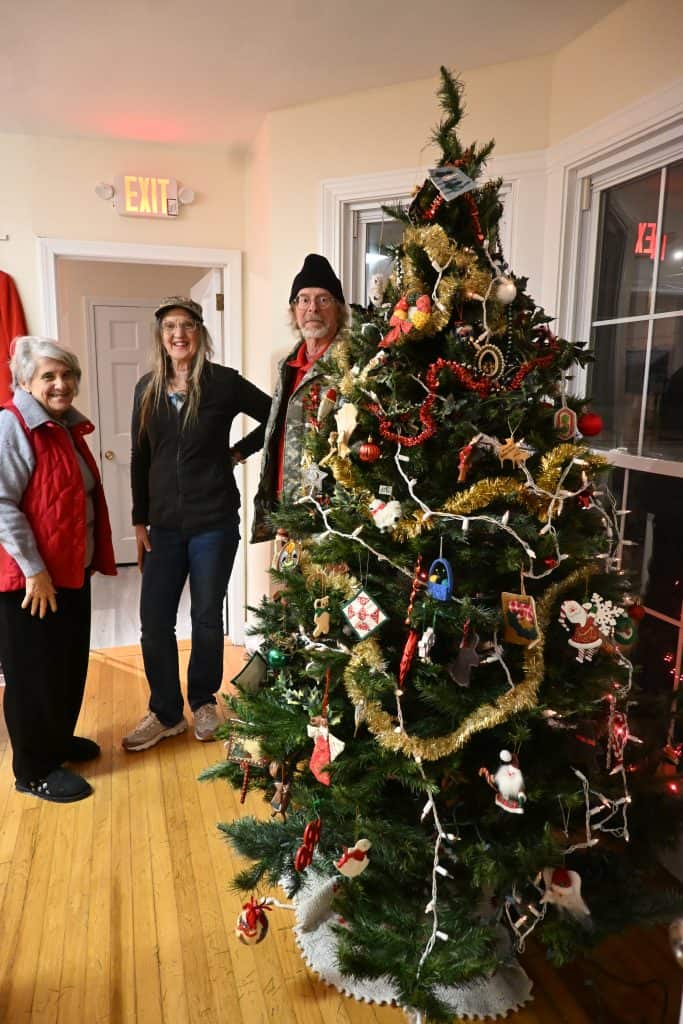

Here’s what’s blooming in town this week to make your walks more enjoyable
By Laura Eisener
It has been common since November to see cars driving by with trees strapped to their roofs. The most popular Christmas tree species in New England is the Fraser fir (Abies Fraseri), a close relative of the more northern balsam fir (Abies balsamea), both of which have the distinctive fragrance so often associated with old-fashioned Christmases. The aroma is so much a part of the season that there are scented candles and fragrance sprays that help provide the scent if you have an artificial tree or no tree at all. Fraser fir and balsam fir are also the most popular wreath material. The needles are bright green on their upper surfaces and somewhat silvery underneath.
A walk around town this week will show many festive displays, and you will glimpse seasonal decorations through lighted windows of many homes. At the library, a brightly lit tree glows from the second story window, and if you go inside you can see other decorations throughout the building. Looking out from the second floor shows a different view of the town’s brightly lit trees, and this week the menorah’s candles are glowing on the Town Hall lawn. Santa Claus has been making many appearances, including one at St. John’s Church Fair last week where he relaxed a bit in front of the “warming tree” where people had donated hats, scarves and mittens to keep others warm this winter. Trees also appear in the storefronts and many churches. The bay window of the Historical Society/SCTV building on Main Street is also lit and decorated. It includes handmade decorations made by talented Saugonians over the years, including some beautiful tiny quilts made by Margie Berkowitch. Dolores Venetsanakos, Joanie Allbee and Paul Kenworthy helped light and decorate the tree this year.
If you are thinking of giving gift plants for the holidays, it is a good idea to consider plants that require minimal maintenance. They are popular hostess gifts and can be very cheerful on windowsills, especially during the next few months when the outside plants are dormant. Poinsettias have long been among the most popular both as decorations and gifts. They are easy to take care of and can last as a houseplant long after the “flowers” fade. However, it is a bit more difficult to get them to bloom again for the following Christmas and those after that. In order to induce flowering, it must get at least 12-14 hours of darkness each night. This might mean moving it to a closet that is not opened and receives no light for the required time period or covering it with a cloth or box to block light out. You have to still remember to water it and be careful of real or artificial light “leaking” through cracks or openings in the closed area during this time.
There are some other plants that require less careful attention. Norfolk Island pines (Araucaria heterophylla) have long been popular tabletop trees, as they do well in room temperature and can be decorated like other evergreens. They are named for an island off the coast of Australia where they are native. I have had one for several years that gets “decorated” for other holidays throughout the year. Other popular plants include kalanchoe, especially those with red or white flowers. These are long bloomers that require minimal water.
Christmas Frosty Fern (Selaginella Kraussianna variegatus) is among the newly popular plants with winter interest that can be grown indoors in our climate. They do not have a flower, but they are an attractive evergreen groundcover from tropical areas that would not survive outdoors here and thrive in the 60-70 degrees or so that most homes are kept. They do like moist environments so could be good candidates for growing in a terrarium, or could benefit from occasional misting. They prefer moist but not waterlogged soil, and they like medium-low light conditions similar to the shady locations where they would grow in their native habitats.
Another good option is one of the new White Wonder Mee bellflowers (Campanula haylodgensis ‘White Wonder Mee’), which is often sold in 4″ pots that can fit on a standard windowsill, and which have tiny snow-white double bell shaped blossoms. This one is actually hardy to zone 3, so could be planted outside in spring once the soil warms up enough, and could adjust to life in the garden. Indoors, the blooms will most likely last for over a month if fading flowers are snipped off regularly.
Editor’s Note: Laura Eisener is a landscape design consultant who helps homeowners with landscape design, plant selection and placement of trees and shrubs, as well as perennials. She is a member of the Saugus Garden Club and offered to write a series of articles about “what’s blooming in town” shortly after the outbreak of the COVID-19 pandemic. She was inspired after seeing so many people taking up walking.