English
 Spanish
 Portuguese
 Arabic
 Haitian Creole
 Chinese (Traditional)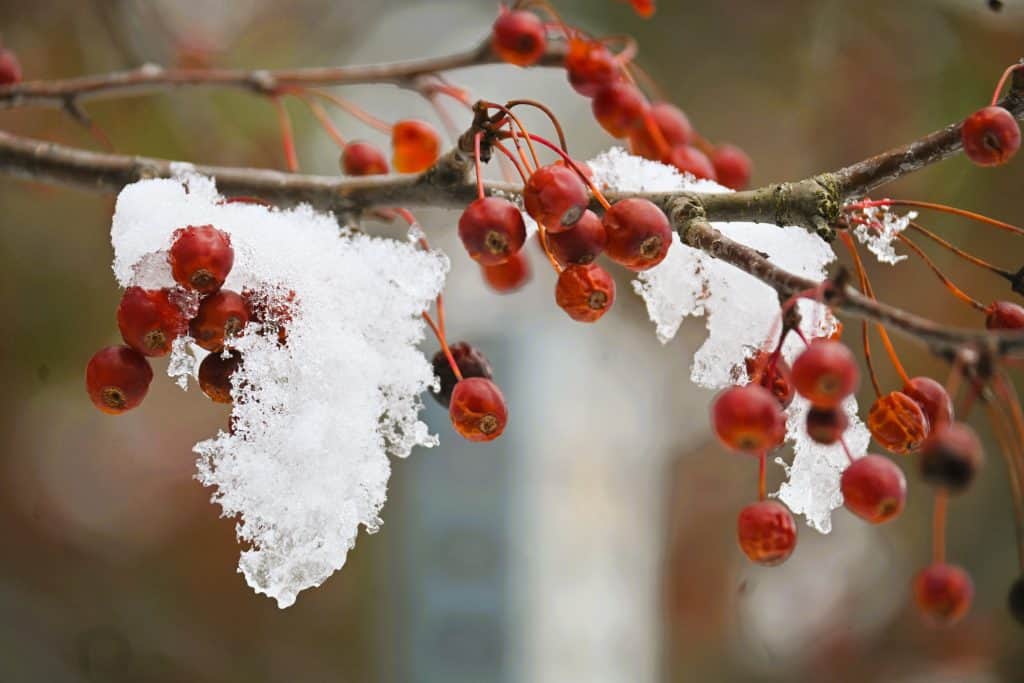

Here’s what’s blooming in town this week to make your walks more enjoyable
By Laura Eisener
We certainly had some significant snowfall on Monday, turning the whole town into a winter wonderland. Throughout the day, while snow continued to fall, I saw a lot of people clearing their driveways and walks. On some streets it looked as though residents were practicing their synchronized snow blowing for the upcoming winter Olympics! New Patriots’ banners and lawn flags had sprouted through the snow. The sailor on the Civil War monument confided that he is hoping to have a new jersey in a few weeks for the first time in several years! I did, of course, warn him not to speak too soon and jinx it.
A thick coat of fluffy snow coated the branches of all the trees and the rooftops between Sunday night and most of the day on Monday. I woke up several times in the night to watch it fall in the glow from the streetlight, and Monday morning the landscape looked completely different than it had the previous day. In locations where the sunny afternoon caused melting, in some places it refroze to create icicles on branches and roof edges. While there were only a few small icicles on the front of the Breakheart Visitors’ Center on Monday afternoon, the back side of the building had a long continuous row of them, just a few inches long, hanging straight down as you would expect. In contrast the wind blows the branches of a French pussywillow (Salix caprea) to-and-fro beside my house, and as a consequence the icicles there develop odd curves and unexpected shapes and even seem to hang sideways at times. In keeping with the feline theme of the shrub’s name, the icicles remind me of the fangs of a saber-tooth tiger or, perhaps, large ferocious, transparent claws! In other areas of the plant, the snow had not yet melted off the branches until nearly dusk.
This is one of the first shrubs to bloom in winter, blooming as early as December and as late as March in past years. This European relative of our native pussywillow (Salix discolor) has somewhat larger buds than the local one, but they are similar in appearance. Both are wind pollinated. The seeds are also often dispersed by wind or water, so new plants may appear where no human gardener planted them.
In addition to having the first blossoms of the new year, the landscape is not yet done with the fruits of the past season. When walking in Breakheart near the end of the snowfall on Monday, I noticed some goldfinches (Spinus tristis) feeding on tiny red crabapples (Malus spp.) and shaking the snow off the branches as it fed. Both male and female goldfinches have a subtle buff color in the winter, but as we get closer to their breeding season, the male goldfinches develop vivid yellow feathers. Many birds appreciate the bright red and yellow colors of various crabapple, hawthorn and other fruits that linger well into the end of winter, in addition to the seeds they may find at feeders.
If the wintry weather is not to your taste, some reminders of spring can be enjoyed indoors. While primroses are not among the most frequently seen flowers in our gardens, they appear for sale as houseplants and New Years’ gifts starting the last week of December. English primrose (Primula vulgaris) actually grows wild in many locations in Northern Europe and is hardy for our climate if the soil and moisture is to its liking. Even indoors, the reason the plants may not thrive is that they like to be kept consistently more moist than most other houseplants that are currently popular. Yellow is the most common color but they can also have pink, purple, red or white petals, and sometimes combinations of these colors and yellow nearer the center. By hybridizing them with other primrose species, double-flowering forms have also been made available. If you have a primrose on the windowsill indoors now, you can keep it alive until the ground warms up in the spring and it can be planted outdoors in late April or May, where it may survive as a perennial for several years.
Editor’s Note: Laura Eisener is a landscape design consultant who helps homeowners with landscape design, plant selection and placement of trees and shrubs, as well as perennials. She is a member of the Saugus Garden Club and offered to write a series of articles about “what’s blooming in town” shortly after the outbreak of the COVID-19 pandemic. She was inspired after seeing so many people taking up walking.