English
 Spanish
 Portuguese
 Arabic
 Haitian Creole
 Chinese (Traditional)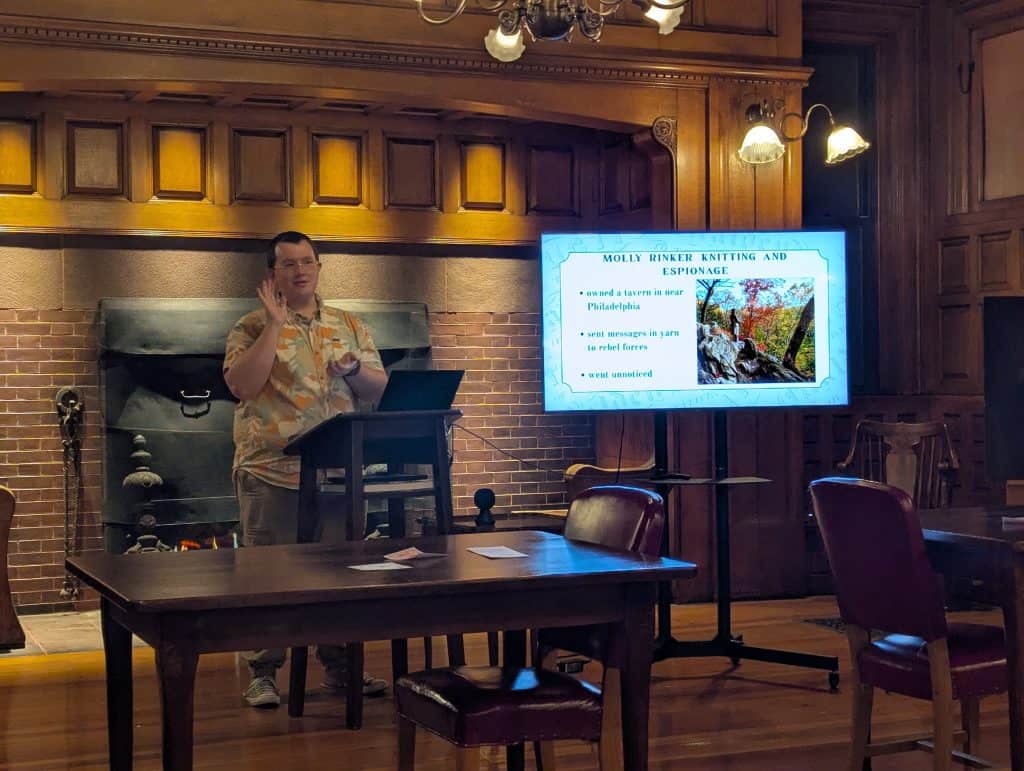

Did you know that knitting is embedded into the history of America’s war effort? Recently, as part of Women’s History Month, the Malden Public Library (MPL) presented a free talk about how women — armed only with their knitting needles — served as spies helping pass military secrets. Starting with the American Revolution, “Knitting was one of the societally accepted ways that women could contribute” to the war effort, according to MPL local history librarian Phillip Wright, who led the talk on March 4, 2026.
When the British Sugar Act of 1764 raised the cost of imported textiles, colonial women led a boycott of those expensive fabrics and began creating their own. But history has recorded more than just women’s resistance. There are many stories about how their knitting helped ensure victory for U.S. and allied armies.
In a 2012 article, the Textile Society of America noted, “Knitting is so cozy and unthreatening that its very execution has been used to cover subversive deeds, though history books rarely include the stories of female characters like [Molly] ‘Old Mom Rinker.’” In 1777, Rinker owned a tavern in Germantown, Pennsylvania, where she served drinks to British soldiers who had occupied Philadelphia. She would listen carefully to their conversations, and after the tavern closed, she “wrote meticulous and copious notes full of information that the soldiers had discussed all evening while drinking. She wrapped her notes around stones, then wound knitting yarn around all the information,” according to the Philadelphia Corporation for Aging.
During the day, Rinker would sit on a rock high above Wissahickon Valley knitting socks for soldiers. No one really took notice when she would throw balls of yarn down the hill. Waiting below, General George Washington’s soldiers would pick them up and return them to camp, where the balls were unraveled to reveal information about British troop movements. History recorded American General John Armstrong saying that without Old Mom Rinker’s guile his troops would have been doomed.
Knitting and other needle arts remained an important way for American women to contribute to war efforts — by knitting hats, socks and scarves for soldiers and stitching political messages into quilts and banners. In an interview with PBS NewsHour, historian Laura Sapelly explained, “The quilt became a political agent for temperance women. It expressed their support of the cause, even if it was on a bed [or] if it was hung on a wall.”
Wright, a knitter himself who teaches needle arts classes at MPL, shared other tales of how women used knitting to hide secret messages during World War I and World War II. Among the most notable knitting agents was the British spy Phyllis Latour Doyle, who hid Morse code messages on pieces of silk she carried in her knitting bag. Her dispatches helped Belgian resistance networks track German Army movement.
“Making knitted garments for soldiers was one of the socially acceptable ways of the time that women could participate in the Revolution” and beyond, according to Wright. Daring and opportunistic, women have played an important role in the establishment of the United States and the efforts to protect freedom and liberty.
MPL is a private, nonprofit corporation that was established with a trust fund from Elisha and Mary Diana Converse in 1885. Today, a board of nine volunteer trustees oversees the trust, which pays for the building’s maintenance, renovations, artwork and books.