English
 Spanish
 Portuguese
 Arabic
 Haitian Creole
 Chinese (Traditional)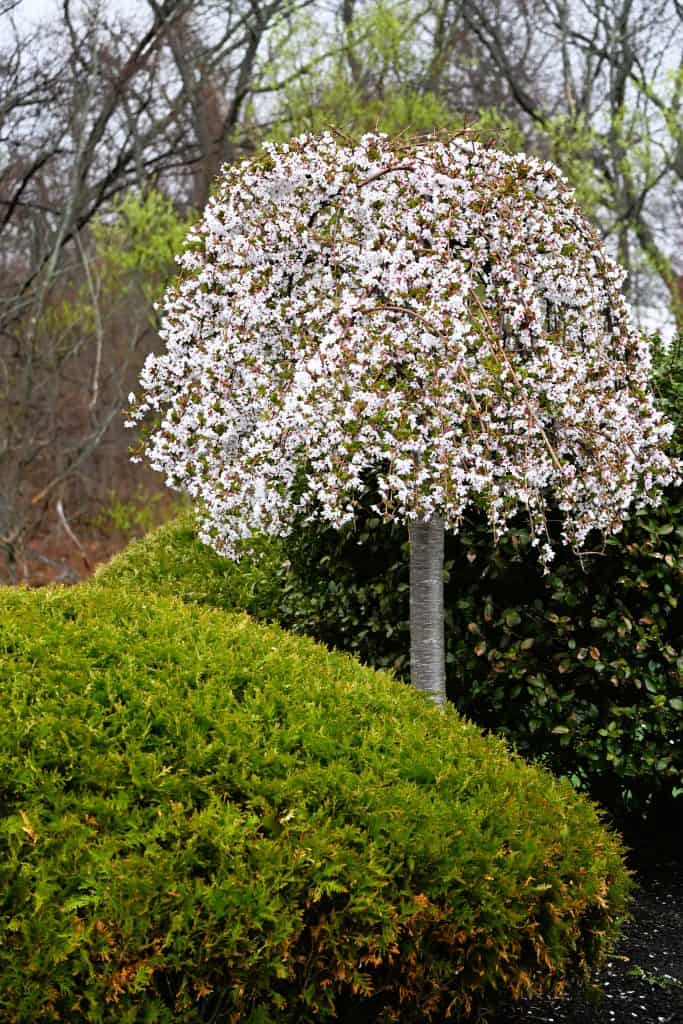

Here’s what’s blooming in town this week to make your walks more enjoyable
By Laura Eisener
Today is Arbor Day, and during this 250th anniversary of the American Revolution we may be thinking of the role trees played in the American Revolution as well as appreciating the importance of trees in everyday life. Many tall pines were branded with the king’s broad arrow — trees that were confiscated for masts for the king’s navy. Since local ships needed mast timber, too, this became an especially sore point in the colonies, and the pine tree became a symbol of protest and was depicted on flags and the pine tree shilling.
Many communities chose a large old tree in a central location to gather under to discuss plans for resistance, such as the famous Liberty Tree in Boston. Colonists met under this old elm (Ulmus americana) near the common to discuss acts of protest against the monarchy, unfair taxes and other grievances. They hung effigies of the stamp collector Andrew Oliver and others in the branches. When the loyalists cut down the tree and burned the branches, there was outrage throughout the town. Thomas Paine wrote a poem about the Liberty Tree in 1775 after this event, the last lines of which are “Let the far and the near, all unite with a cheer, In defense of our Liberty Tree.”
Here in Saugus, one tree long stood on Main Street that was connected with our town’s revolutionary activities. Planted by Rev. Joseph Roby, often called Parson Roby, a leader in planning the town’s revolutionary activities, this American elm stood from the 18th century into the 20th, when it died of Dutch Elm disease. Wood from the tree was made into gavels, and a cross-section of the trunk was varnished to preserve it by the late Carmine Moschella.
Back to the present: Tomorrow, Saturday, April 25 will be the Annual Arbor Day Clean Up and Maintenance at the Tree Farm. At this farm have been raised many trees that now grace streets and public places, such as former and present school grounds. Many of these were cared for by members of the tree committee and other volunteers over the years.
As spring advances, we move from the mostly wind-pollinated blossoms of early bloomers to the showy blossoms that are pollinated by bees and other pollinators as the weather warms to be more hospitable to insects. We are seeing star magnolias (Magnolia stellata) near the end of their bloom period, and a few cherries and plums at the peak of theirs. Weeping cherries (Prunus subhirtella pendula) may have pink or white blossoms, depending on variety, and are among the most popular in every part of town. There are other cherries and plums blooming now as well — the pale pink fragrant blossoms of the Japanese hybrid Yoshino cherry (Prunus yedoensis) are blooming now, and petals will fall as the leaves begin to emerge. Flowering plums, sometimes called cherry plums, such as the purple leafed ‘Newport’ plum, often have very small pale pink blossoms followed by purplish foliage. One more Asian cherry species will bloom later, perhaps a month from now, the Kwanzan cherry (Prunus serrulata ‘Kwanzan’), which has double pink blossoms and leaves that emerge a coppery color but slowly change to green as summer advances. Many of the cherries also have great fall color.
Today is the sixth anniversary of this column. The first one, published on Arbor Day, April 24, 2020, in the midst of the pandemic, featured pictures of forsythia near Walden Pond Avenue and the magnificent cherry on the Town Hall lawn — blooming again this week.