English
 Spanish
 Portuguese
 Arabic
 Haitian Creole
 Chinese (Traditional)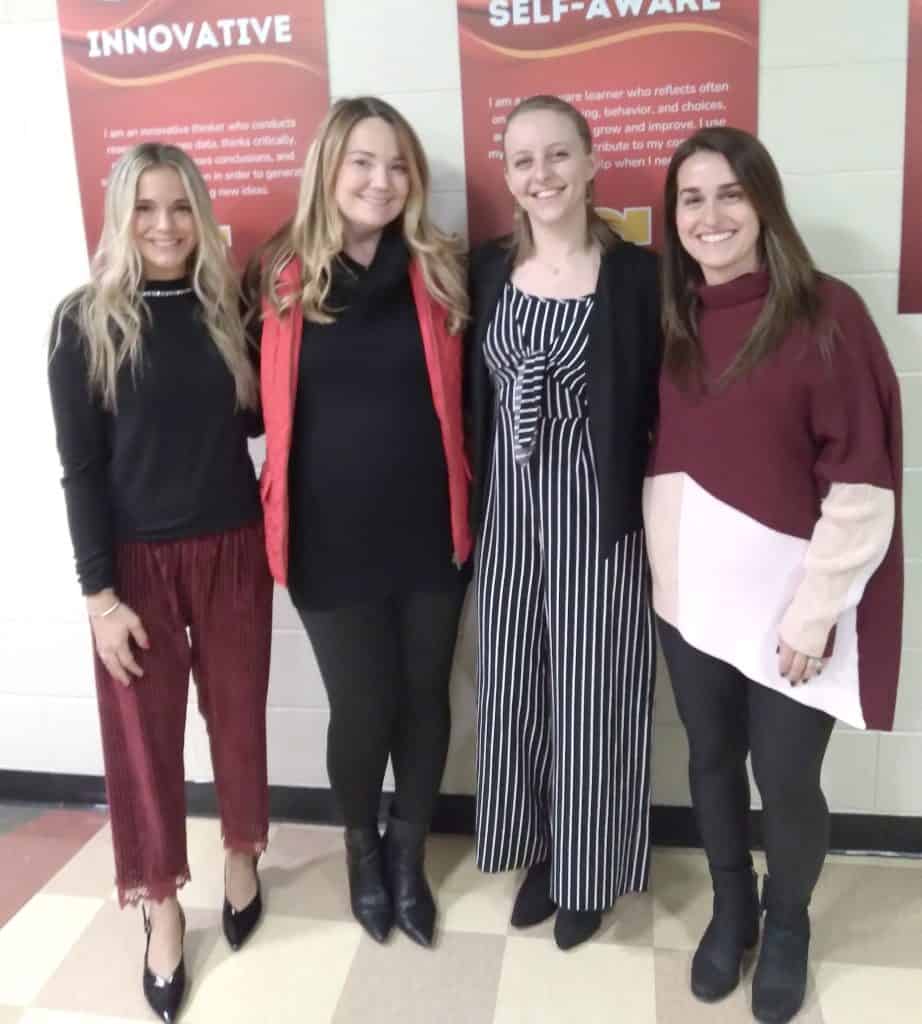

By Neil Zolot
Whittier School 6th grade English Language Arts (ELA) teacher Kassidy Butt and science teacher Rachel Hughes had an idea to teach a unit on yellow fever together combining both subjects. They were aided by English as a Learned Language (ELL) teacher Krista Davis and Special Education teacher Carmela Tiberi. “It was a great example of how teachers can take two subjects and put them together,” Whittier principal Michael McLucas said at the School Committee meeting Monday, December 15.
“Our 6th grade team worked on a lesson that connected our ELA unit on yellow fever with a science investigation,” student Kayden Michael explained. “In ELA we learned about three theories for what caused yellow fever, bacteria, contaminated material and mosquitos. During the bacteria theory lessons our teachers helped us explore this scientifically.”
“In ELA we read about the yellow fever outbreak in Philadelphia in 1793,” student Soleyana Mehari added. “We studied the symptoms people had and learned about how people did not really know what caused the disease back then.”
“After observing bacteria, we connected what we saw to what we were reading in ELA,” student Kaleb Borges continued. “After the experiment, we talked about how it made sense to the scientists at the time that bacteria could be the cause of yellow fever. It was really gross.”
“In science, we got to observe real bacteria in petri dishes,” student Sandrey Masdoisan continued. “We looked at the colonies closely to see how they grow and spread. In science class, the week before we went around the school and swabbed different things around the school to watch bacteria grow on them over time.”
“We learned that bacteria can spread, but they do not spread the same way yellow fever did in the book,” student Janat Oulmassi continued. “This helped us question the bacteria theory and think about what other causes made more sense.”
“This lesson showed us why it is important to connect what we learn in different subjects,” student Anthony Galdamez concluded. “It made the ELA story feel more real because we actually tested one of the theories ourselves. If it was not for the science lesson, I would not even know what bacteria looks like in real life to see if it made some sense for it being the cause of yellow fever.”
“Our project also connects to something our district is focusing on this year,” student Nicolas Blanchard wrapped up. “Our teachers want to make sure all students get the reading support they need to succeed. In this activity we practiced important reading skills like understanding text, using evidence and explaining our ideas. Our teachers could see what we understood and what we needed help with because we used both science data and details. This helped us improve our reading, vocabulary and comprehension while doing something hands-on and fun. We hope the project shows how powerful it can be when subjects work together.”
His mother Antoinette Blanchard said Nicolas “likes to do research on things that interest him.”
He confessed to feeling a little nervous addressing the School Committee at first, but settled down once he started.
Superintendent William Hart said the project “shows us how to build lessons around two subjects.”
In other news, the City Council set the tax rates for Fiscal 2026 in a special meeting Thursday, December 11 after technical problems with ECTV forced cancellation of a meeting Monday, December 8. “It was passed unanimously as proposed,” Councillor at-Large Katy Rogers said in regard to the Minimum Residential Factor being set at .774312 in a shift from a uniform rate for all properties to a greater burden on Commercial/Industrial Personal (CIP). As a result, for every $2 in property taxes $.77 will be residential property taxes and $1.33 will be CIP.
The Residential Tax Rate Exemption was set at 25%, which will also help lower taxes for many people. It is the amount taken off the tax bill for homeowners that live in their homes in their community. It reduces the amount they are taxed on. The Residential Tax Factor is the formula used to get the Residential Tax Bill. 4,324 parcels qualify.
Under the Residential Tax Factor, residents would be taxed at .75% of each dollar, with the dollar value of their home decreased for tax purposes.
Also passed were resolutions appropriating $6,000,000 from the Budgetary Fund Balance (Free Cash) to reduce the Fiscal 2026 tax levy, $750,000 from the Water/Sewer Budgetary Fund to offset water and sewer rates and $250,000 from the ECTV local cable TV Budgetary Fund Balance to offset costs for ECTV.