English
 Spanish
 Portuguese
 Arabic
 Haitian Creole
 Chinese (Traditional)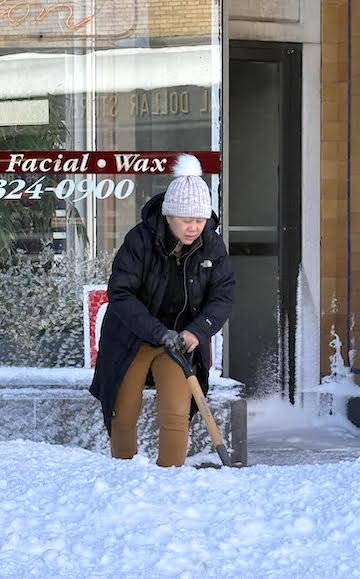

Storm, aftermath closes schools for 2 days, causes treacherous travel conditions
By Steve Freker
A powerful Nor’easter that attacked the entire Eastern Seaboard — from Maine through the Mid-Atlantic states — lived up to its billing and earned its rightful name, “The Blizzard of 2026.” The blizzard raged for nearly 24 hours, from late Sunday night through early Monday evening, just about 21 hours. In the Advocate readership area of Everett, Malden, Revere and Saugus, the storm brought one to three inches of snow per hour, at times, with substantial snowfalls from 16-20 inches in the four communities. The Blizzard of 2026 (dubbed Winter Storm Hernando) brought the entire region and much of the eastern portion of Massachusetts to a standstill, closing all schools for two days, both Monday and Tuesday, and making travel treacherous throughout.
The National Weather Service defines a blizzard as a storm that contains large amounts of snow or blowing snow, with winds in excess of 35 mph and visibilities of less than a quarter mile for an extended period of time, at least three hours. All of these criteria were met, with winds averaging well over 50 mph for most of the storm. In the South Shore, winds were recorded at a record 83 mph on Cape Cod, the force of a Category 1 Hurricane.
Despite sporadic power outages caused by the combination of heavy wind, downed tree limbs and subsequent downed power lines, there were little if any outages reported or addressed in the Advocate readership communities.
Snow emergencies and the parking bans that accompany them were declared in all four communities, while Mass. Governor Maura Healey declared a state of emergency in Massachusetts at 12 noon on Sunday, ahead of the storm, and it remained in place through Tuesday evening, expected to be lifted by late Tuesday ahead of Wednesday morning. Classes were scheduled to resume in all four communities as of information available just before Advocate press time.
Local Department of Public Works (DPW) crews worked around the clock, beginning Sunday evening and well into Tuesday and Wednesday, battling the blizzard and its aftermath. DPW crews — assisted by a bevy of outside contractors — were out in force in all four communities, ahead of the storm on Sunday, laying down sand and salt, preparing the roads for the impending Nor’easter. By early Monday morning, at the height of the storm, DPW plows and other apparatus were out on the main roads working on clearing them and making them passable.
With the snow emergencies and subsequent parking bans in effect, Malden offered free parking in several school lots as well as both Malden Square downtown parking garages; Everett offered free parking in some school and municipal lots; and Saugus also offered free parking at the Saugus High and Middle School lot and at the Anna Parker lot. Nonetheless, dozens of cars whose owners neglected to follow the guidance of their respective communities were ticketed and towed to clear main streets so the plows could do their jobs.
For the first time in recent memory, Massachusetts experienced the brunt of the massive storm, with several communities in the South Shore smashing previous snowfall records with over three feet of snow. The city of Fall River, Mass., had the highest snowfall in the state and among all Eastern Seaboard states with a whopping 41 inch snowfall.
Locally, in the Advocate readership area, all of our communities were hit with substantial snowfalls. Malden led the list and got whacked with over two feet of snow — 20.0 inches in all — from the Nor’easter’s start, around 11 p.m. Sunday night, February 23, until the storm subsided, with snow halting around 8:00 p.m. Monday, February 24. While Boston Logan Airport recorded 17.3 inches of snow, Everett had 17.1 inches, Revere had 16.5 inches and Saugus recorded 16.0 inches.
In two of the Advocate readership communities, it was the first blizzard of people’s new tenure overseeing storm management, with Everett Director of City Services Bob Knox in the first month of his new post, after over 30 years with the Malden DPW, and Paul Myers as interim DPW Director in Malden, also in his first month in that designation. Both have weathered many similar operations in these and other communities over the past two decades.
All four readership communities hire a number of outside snowplow operating contractors when storms hit, and despite a regional shortage of snowplow drivers, all initial reports from the four communities is that all did a commendable job clearing out from the first recorded blizzard in four years.