English
 Spanish
 Portuguese
 Arabic
 Haitian Creole
 Chinese (Traditional)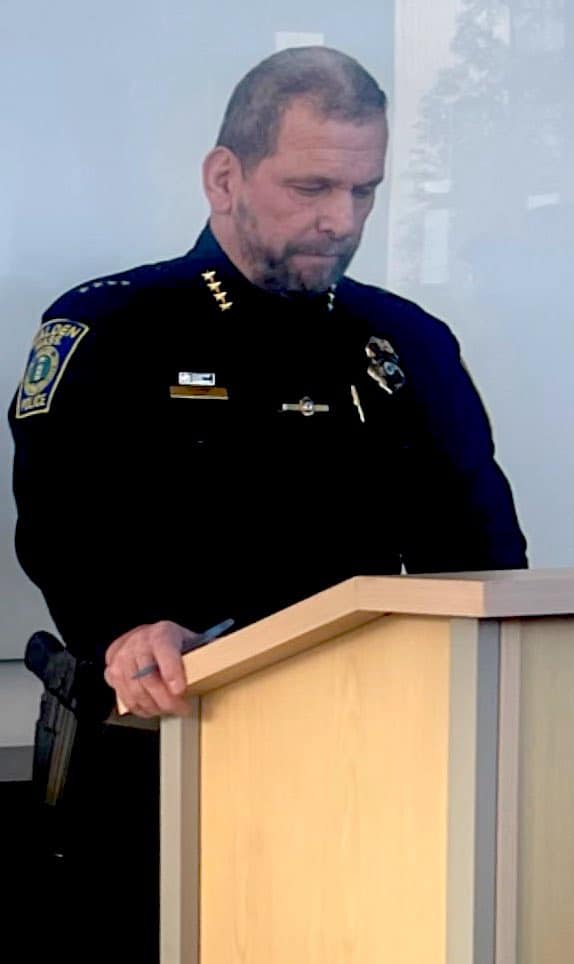

Malden Police Chief Glenn Cronin read the following statement at the recent Malden City Council meeting with a call for City Council Order 72-26, which partly read: “No city employees, departments, appointees, processes or representatives shall assist in fulfilling the unique and separate responsibilities of the Federal government, including
immigration enforcement, or cooperate with any Federal agencies or policies contrary to the stated goal of this Order.”
As someone who has interacted with this community in a law enforcement capacity for over 30 years, I’d like to believe that the vast majority of our residents would support any goal of a safe, livable and welcoming community. As Chief, it’s at the core of what we do every day, while striving to protect the rights and dignity of all members of our community. That said, the proposed “order” is not one that I support for several reasons.
We are a department guided heavily by state laws (MGL’s), Code of Mass Regulations (CMR’s) and our departmental policy, in particular, our State Accreditation policies which guide absolutely everything we do. Injecting this “order” language into our policies would be contrary to many of the policies enacted by the state and codified in our State Accreditation policies. Adopting local ordinances that must be reconciled with these simply leaves too much room for interpretation. In fact, the very wording of ‘safe, livable, and welcoming’ is subjective and means different things to different people. It is both unfair and unrealistic to expect our police officers to interpret this in a way that meets the goals of the cosponsors. I suspect the same goes for other city employees and departments as well. I’m aware that many city departments have partnerships with the federal government. The MPD, MFD, MPS, MHA, Office of Strategic Planning and Community Development (OSPCD), just to name a few, have all received federal funding and/or training at one point or another and many annually.
A categorical prohibition on assisting or cooperating with federal agencies risks intentionally impairing these critical functions, even when that cooperation has no connection to immigration enforcement and directly serves local public safety priorities. Federal agencies are connected to the Malden Police Department in the same manner they are connected to most mid-sized municipal police departments: through formal, routine, and legally authorized mechanisms. These connections primarily arise from joint task forces, grant funding, intelligence sharing, training programs, and emergency-response coordination administered by the Department of Justice. For example, Malden officers participate in FBI-led task forces (such as Joint Terrorism Task Forces, violent crime initiatives, missing and exploited children, Bank Robbery Task Force, and others), we work with ATF on firearms tracing and gun-crime investigations, coordinate with DEA partners on narcotics trafficking and enforcement, and we work with the U.S. Marshals fugitive task forces. These relationships are standardized nationwide and typically governed by memoranda of understanding, agreements, or grant conditions, which we currently have.
In addition, federal involvement commonly flows through an administrative and operational infrastructure. This includes DOJ grant programs (e.g., Byrne JAG, COPS), access to federal databases and intelligence products via regional fusion centers, in our case the Commonwealth Fusion Center (CFC), FEMA coordination during disasters, and federally provided training
through institutions like Federal Law Enforcement training centers (FLETC) or the FBI National Academy.
None of these connections are unique to Malden, these are connections available to all municipalities across the country. This is a standard policing model, in which municipal departments are integrated into a multilayered federal, state, and local law-enforcement system. These connections are ordinary, transparent, and policy-driven. To sever our ties to these critical federal partnerships would be completely irresponsible and would undoubtedly place our community in the dark, out of touch, and in danger. Information is the lifeblood that ensures a safe, livable and welcoming community.
Contrary to the goals stated in the “order,” it’s important to understand that police officers are not situated in the same way as other municipal employees or departments. By the very nature of our profession, local law enforcement agencies such as ours are inextricably connected to a wide range of state and federal law enforcement partners. These relationships are not discretionary or political; they are rooted in statutory obligations, court orders, task force participation, information-sharing requirements, and long-standing public safety mechanisms.
Many of these communications occur through mandatory reporting channels that exist specifically to safeguard our local community from serious crime, violence, terrorism, human trafficking, narcotics distribution, and other threats. A blanket statement that “no city employees shall assist in fulfilling the unique and separate responsibilities of the Federal Government” is excessive and risks undermining legitimate and necessary public safety functions. This approach, to me, reflects a reaction to a complex and problematic national issue rather than the operational realities of local policing. Effective public safety requires limited, purposeful communication with federal partners when it directly advances the protection of our community, and needs to be free to be accomplished without a subjective set of goals.
While the proposal states that the “order” “shall not require the City to break preexisting contracts or agreements with Federal entities” this appears intended to mitigate legal risk, it introduces significant confusion and operational challenges.
The term “pre-existing” is inherently subjective and undefined. This creates uncertainty as to which agreements are covered, how long they are covered, how they are interpreted, and who determines whether a given activity falls within or outside the scope of a protected agreement. More importantly, the language would appear to prohibit the City, and by extension the Police Department, from entering into any future contracts, expired contracts, memoranda of understanding, task force agreements, or grant-related arrangements with federal agencies, regardless of their purpose or benefit to the community. This could effectively freeze the Department’s ability to adapt to emerging public safety needs, access federal resources, or participate in lawful cooperative efforts that are routine for local police departments. I’m going to provide you with two examples of how critically important our ties are with our federal partners:
Just a few years ago, the cities IT system was hacked. Through a partnership with the United States Secret Service (whom we have no existing agreement or contract) responded immediately and through their specific expertise, mitigated what could have been a catastrophic release of information. My point is that if this “order” was in place, at that time, reaching out and contacting the Secret Service would have been a violation of the “order”, this makes no sense…
In another disturbing case, there was a recent press release by the United States Attorney’s Office (District of Massachusetts). The headline read, “New York Man Convicted of Sex trafficking a Minor and forced labor.” He was convicted by a federal jury for sex trafficking of a minor by force, fraud, and coercion, transportation of a minor with intent to engage in criminal sexual activity, and forced labor. No verdict can replace the pain, suffering, and lifelong trauma for the victim, but the perpetrator will be incarcerated for a number of years and unable to reoffend. I mention this case as the young child was a Malden resident. Det. Bob DiSalvatore and Det. Renee Kelley worked closely with our federal partners in the FBI to bring this case to a conclusion and conviction.
Finally, from an enforcement and compliance perspective, the scope of the language prohibiting assistance with “the unique and separate responsibilities of the Federal government” is so difficult to apply in practice. Many law enforcement activities involve overlapping jurisdictional responsibilities, shared intelligence, or parallel investigations. Without clear, objective standards, the proposed “order” places officers and supervisors in untenable positions where routine, lawful police work could be construed as a violation, exposing the City and its employees to unnecessary legal and operational risk.
I am aware that this proposed “order” is a reaction to the Immigration and Customs Enforcement (ICE) operations. I sent the council a Community Newsletter back in January of 2025 outlining our role as it relates to immigration enforcement. Every word in it, is still true today.
At the same time, it is critical for me to be clear: the Malden Police Department does not enforce federal immigration law, will not enforce federal immigration law, and will not divert local resources for civil immigration enforcement. Our officers’ role is to uphold state laws and regulations, departmental policy, protect constitutional rights, and ensure that all community members, regardless of immigration status, feel safe reporting crimes, seeking assistance, and engaging with law enforcement.
I remain committed to this department maintaining communications with federal agencies, regardless of existing contracts or agreements, to the extent required by law and operational necessity, and only when such communication directly serves legitimate public safety purposes. This allows us to safeguard the rights of all community members, preserve trust between the police and the public, and continue to fulfill our sworn duty to protect the City of Malden.
In closing, as the Chief of Police being charged with the responsibility of our communities’ safety, I respectfully ask the council not to support this unenforceable proposed “order.”
Thank you very much.
Chief Glenn Cronin
Malden Police Department