English
 Spanish
 Portuguese
 Arabic
 Haitian Creole
 Chinese (Traditional)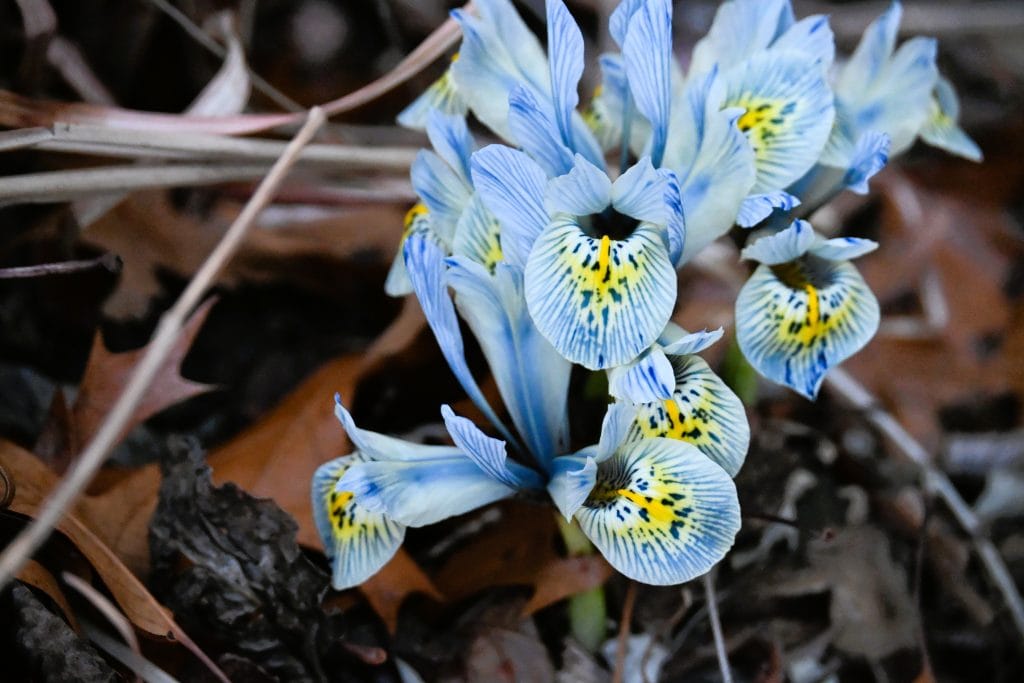

Here’s what’s blooming in town this week to make your walks more enjoyable
By Laura Eisener
A week past the vernal equinox traces of winter remain. Here and there we can find traces of grayish snow not quite melted. While the grass is not as green as we might like to see, there are signs of spring everywhere if you look carefully. A walk in the woods will reveal some green moss on fallen logs, and while bodies of water have thawed and refrozen in parts several times in recent weeks, most of them are now open water with almost no ice. Last Sunday I saw a lot of robins running around the grass at the Walnut Street cloverleaf at Route 1 looking for worms and possibly finding some! The top few inches of soil have thawed in some places although it is still not possible to stick a shovel very far into the ground.
While it is still too early to plant outside, it is not too early to plan. We are about a month away from the start of the season for planting trees, shrubs and hardy perennials, and a little more than two months away from the recommended time for planting tender plants like annuals, since there is still danger of frost until Memorial Day.
March 30 is National Take a Walk in the Park Day, and chances are the weather will be warm enough to encourage such activities. Twenty years ago, the American Heart Association began National Walking Day, which is observed on the first Wednesday in April each year. No joke, this year it will fall on April 1.
Silver maples (Acer saccharinum) are among the most common native trees in the United States, with a wide range stretching across eastern and central United States, and parts of Canada as well. While we most often call it silver maple, it is also called by variations, such as silverleaf maple and white maple, still referring to the pale tones of the underside of the leaf; creek maple or swamp maple (but red maple is sometimes called this as well) for its tolerance of wet soils; large maple because of its quick growth and height at maturity; and soft maple because the fast growth produces large cells, which may be more brittle than wood from slower growing maple species. While it develops quickly into a large tree, the branches tend to be brittle, and several trees in town that were planted in the late 19th and 20th century have been removed as a result of broken branches, especially in the Lynnhurst neighborhood.
Like several other maples, including red maple (Acer rubrum), that bloom before the tree leafs out, silver maples are usually pollinated by wind. Male and female flowers are individually fairly small, but can be colorful with reddish and yellow tones, and the fact that they bloom so early makes them something to look forward to. Male and female flowers may both be produced on the same tree, but sometimes one tree will produce all male or occasionally all female flowers, so it facilitates reproduction if there are a few trees in close proximity to each other. This week the sap is still running in the silver maples, and squirrels sometimes break off twigs to sip the sap from broken branches and to nibble on blossoms. I sometimes watch them doing this through my dining room window, since a red maple and a silver maple are both blooming on the street near my house right now. Both of these tree species will produce winged seeds called samaras before the spring is completely over, which will flutter down from the trees a couple of months from now.
Among the early bulbs blooming now is the tiny ‘Katharine Hodgkin’ iris (Iris reticulata ‘Katharine Hodgkin’), which has light blue-veined tepals with yellow and dark blue speckled nectar guides. When I headed out Saturday morning, I predicted that the flowers would be open by the time we returned home that evening, and indeed my prediction was accurate! While most people are more familiar with the bearded irises and flag irises that have much longer stems and larger flowers, these and other very early irises bloom from bulbs, and the flowers are just an inch or two above the ground surface. Like snowdrops, crocuses and other geophytes, they prefer a well-drained soil and become dormant a month or so after flowering. These little irises are resistant to deer and rabbits.