English
 Spanish
 Portuguese
 Arabic
 Haitian Creole
 Chinese (Traditional)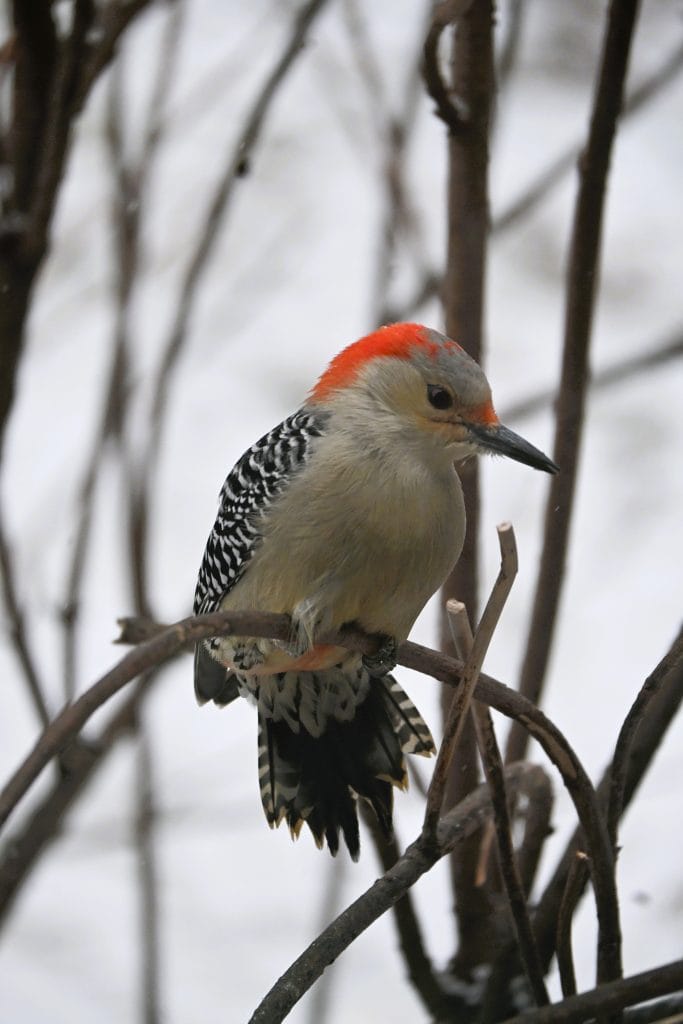

By Laura Eisener
While the snow we have had for several weeks was somewhat dry for snowman building, Kevin the ornamental goose has been dressed as a snowman (or should I say snow goose) with “coal” buttons, a black top hat and a beautiful blue hand-knitted scarf. She seems to have lost her hat in the snow recently; perhaps it will reappear by spring as the snow piles melt. Kevin has a friend nearby: a gnome whose handsome hat seems to be created by the same knitter, sitting on a ledge up against the house. It is a cheerful sight in winter to see them as you walk or drive through Lynnhurst.
The most interesting seasonal changes as you walk through town this week may be the phases of water; over the course of a day or two you can frequently see, and sometimes even hear, water changing from liquid to solid and vice versa as temperatures go up and down near the freezing mark. Often on a sunny day if you stop and listen you can hear dripping as ice and snow melts. The icicles I photographed a few weeks ago are somewhat smaller as daytime temperatures rise above freezing.
Some icicles on the southwest corner of my roof fell onto the ledge below and are now pointing up at crazy angles like spikes. On the northeast side, the icicles are shorter now and their shape and texture have changed; instead of being ribbed on the sides they are smooth but very slightly wavy, and you can see bubbles and a few cracks where the freezing and thawing has formed them into new patterns. On this side they are warmed a bit by the morning sun, but by the time the day has reached its highest temperatures they are back in the shade, and any dripping water has refrozen. The southwest facing icicles in the photo above are the ones that get afternoon light, and frequently at midday they cast shadows on the siding and may be for a short while also reflected in the windows.
Heavy icicles over a walkway or entrance area can be dangerous if they fall suddenly when someone is beneath them, and they also can contribute to the slipperiness of steps, as the fallen icicles melt and refreeze in the evening. In addition to roof edges, they can form on branches and undercarriages of cars, and one morning I went out and saw them hanging from the bottom of my front license plate, as the snow had melted while the hood was warmed by the sun, then refroze as they dripped down into the shade at the car’s undercarriage.
While icicles can form any time the temperatures are cold enough, my own experience over the last several years shows that February could be called icicle month, since there are more of them and they last longer than in any other month of the year in our climate. Often this coincides with the start of tapping the sugar maple trees (Acer saccharum), since in Saugus and adjacent towns the temperatures were right for the start of sugaring season just before Valentine’s Day. It will continue until the night temperatures rise above freezing. The dates vary a bit from year to year, and Breakheart Reservation’s popular Maple Sugarin’ Day will be March 14 this year.
During the great backyard bird count last weekend (Feb. 13-16) I counted six dark-eyed juncos, two blue jays, one tufted titmouse, one black-capped chickadee, one white-breasted nuthatch, three mourning doves, two house sparrows and three squirrels in a 15-minute period on Monday while I was sitting cozily indoors drinking my coffee. The juncos were mostly foraging on the ground, but a few perched in a shrub nearby and then grabbed a seed or two from the feeder before flying off. The sparrows live in the birdhouse that hangs in the silver maple (Acer saccharinum) near the street. The squirrels were running up and down the tree trunk, more interested in each other than in the birdseed.
A bit later in the morning, a red-bellied woodpecker (Melanerpes carolinus) came to the feeder and grabbed some peanuts. This is a large woodpecker, mostly black and white on the back and wings. The belly is actually mostly white with a pinkish blush rather than the bright red that its common name would suggest. Males have more red on the top of their head than females — females have some bright red on the nape of their neck and a small reddish patch just above their beak, but their crowns are white or pale gray.