English
 Spanish
 Portuguese
 Arabic
 Haitian Creole
 Chinese (Traditional)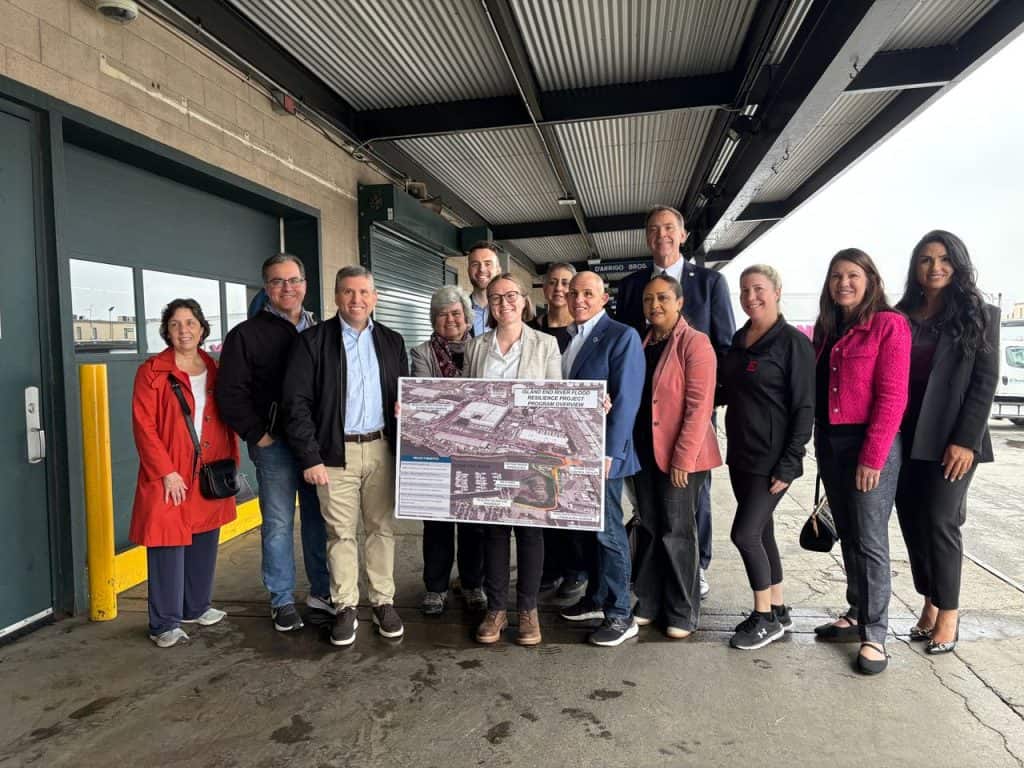

CHELSEA/EVERETT, Mass. – State legislators visited the New England Produce Center in Chelsea last Friday to learn more about increasingly severe flooding that threatens the food supply for more than 9 million people in New England and beyond.
The New England Produce Center is the largest wholesale produce market in the region and a cornerstone of the food supply chain, distributing fresh food to grocery stores, restaurants, schools, hospitals, and institutions across Greater Boston and throughout New England and the Canadian Maritime provinces.
The produce center sits in the floodplain of Island End River, a tidal tributary of the Mystic River that frequently overtops its banks. Flooding is growing more severe each year and will become catastrophic as sea levels rise.
Disruption to the produce center due to flooding would have consequences far beyond Chelsea and Everett, threatening regional food access, economic activity, and supply chain stability.
Officials used the visit to highlight the importance of the Island End River Flood Resilience Project, which has been under development by the Cities of Chelsea and Everett for more than a decade to address this critical vulnerability. Developed in response to growing risks from storm surge and sea level rise, the project is designed to protect the produce center, thousands of residents in surrounding neighborhoods, and interconnected transportation and utility infrastructure.
The project includes a linear flood barrier, underground tidal gates to prevent and manage storm surge, and new public access improvements, including an elevated riverwalk, a new Island End Park, and restored wetland habitat.
The tour gave legislators an opportunity to hear directly from Chelsea City Manager Fidel Maltez, Everett Mayor Robert J. Van Campen, and other local leaders about the urgency of advancing the project and the importance of sustained state and federal support to protect this critical regional asset.
“This visit made clear that protecting the New England Produce Center is not just a local priority, but a regional imperative,” said Chelsea City Manager Fidel Maltez. “For more than a decade, Chelsea and Everett have been advancing the Island End River Flood Resilience Project because we understand what is at stake. This project protects critical food infrastructure, strengthens supply chain resilience, safeguards surrounding communities, and represents the kind of forward-looking investment we need to meet the challenges of climate change.”
“The flooding we see along the Island End River is not just a future threat,” said Everett Mayor Robert J. Van Campen. “It is happening now, and it is getting worse. Residents, businesses, and critical regional infrastructure like the New England Produce Center are all at risk. Chelsea and Everett have been driving this project forward for more than a decade, and we are grateful for the opportunity to show our state partners firsthand why this investment matters so much to our communities and the region.”