English
 Spanish
 Portuguese
 Arabic
 Haitian Creole
 Chinese (Traditional)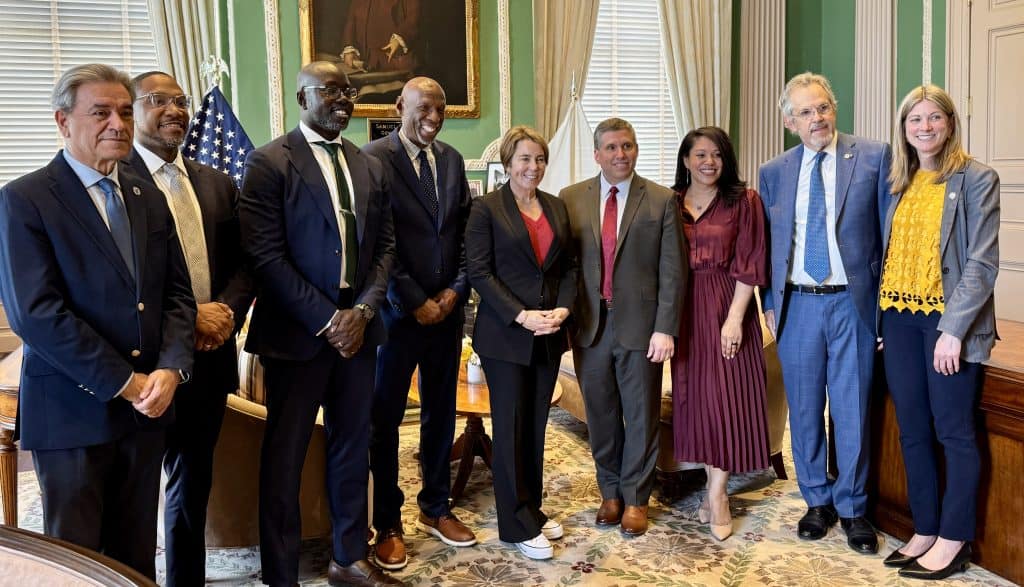

Special to The Advocate
State Senator Sal DiDomenico filed a transformational anti-poverty bill — called the ENOUGH Act — after visiting the Harlem Children’s Zone in New York, where he learned about their nationally recognized program that is breaking the cycle of intergenerational poverty, building community and creating meaningful opportunities for thousands of children and families. DiDomenico brought a full-court press to push his bill alongside the Harlem Children’s Zone (HCZ) President and Founder, Geoffrey Canada, former Secretary of Education Paul Reville and the Massachusetts House sponsors of the bill. The Senator hosted a Press Conference, galvanized hours of testimony during the bill’s first hearing, collected cosponsorships from 75% of the Senate and held productive meetings with Governor Maura Healey, Lt. Governor Kim Driscoll and Senate President Karen Spilka.
The official title of the ENOUGH Act is An Act creating the engaging neighborhoods, organizations, unions, governments and households fund. Modeled on Maryland’s ENOUGH Act, this legislation will create an innovative strategy to fight poverty by investing resources in high-need neighborhoods and collaborating with community residents to help drive decisions that will ensure investments increase economic mobility.
On May 7, 2026, the ENOUGH Act had a hearing before the Legislature’s Joint Committee on Community Development and Small Businesses and received testimony from HCZ’s Geoffrey Canada, the House sponsors of the bill, Kate Lipper-Garabedian and Antonio Cabral, former Massachusetts Secretary of Education Paul Reville, HCZ CEO Kwame Owusu-Kesse, union leaders, educators, nonprofit executives, anti-poverty advocates, and philanthropic organizations. On Thursday before the hearing, Senator DiDomenico had hosted a press conference at the State House highlighting the bill alongside many of the same leaders and several state senators.
“The Harlem Children’s Zone is a striking example of community, government, and philanthropy working in unison to radically improve thousands of people’s lives for the better and it was inspiring to visit and learn about this seminal project with my Chelsea colleagues,” said Senator DiDomenico. “I am proud and excited to bring this innovative framework here to help combat poverty in my district and all over the Commonwealth. The reason an initiative like this works is because they include holistic and community-driven programs that address the root causes of poverty and offer wrap-around high-quality services across every aspect of life from education to health care to childcare to community building and so much more. I am grateful for leaders like Geoffrey Canada and Kwame Owusu-Kesse who are spreading these ideas across the country and creating opportunities for countless scholars.”
“Every child deserves a community built entirely around their success. A good school is a good start, but an ecosystem of support from cradle to career is how you transform lives — and entire states. The ENOUGH Act builds that ecosystem, and Massachusetts has the opportunity to show the nation what’s possible when a state gets this right,” stated Geoffrey Canada.
“As a former public-school educator, I have seen firsthand how the barriers of poverty can stifle the potential of our students long before they step into a classroom,” said State Representative Lipper-Garabedian (D-Melrose). “I am honored to partner with Representative Cabral and Senator DiDomenico in filing the ENOUGH Act and we are deeply privileged to have the Harlem Children’s Zone (HCZ) working alongside us to bring this vision to Massachusetts. HCZ has proven that cradle-to-career initiatives can effectively break the cycle of generational poverty. By bringing these strategies to Massachusetts, we can provide families with the wrap-around assistance necessary to ensure that every child has a clear, supportive path to success.”
This bill creates a fund managed by the Mass. Executive Office of Housing and Livable Communities to support community-driven, place-based strategies aimed at reducing poverty and improving outcomes for families in underserved neighborhoods. The fund will finance competitive grants for partnerships among nonprofits, schools, local government and other entities to develop and implement comprehensive plans that align housing, education, social services, health and workforce initiatives. An advisory committee of state agencies, experts and providers will oversee the fund.