English
 Spanish
 Portuguese
 Arabic
 Haitian Creole
 Chinese (Traditional)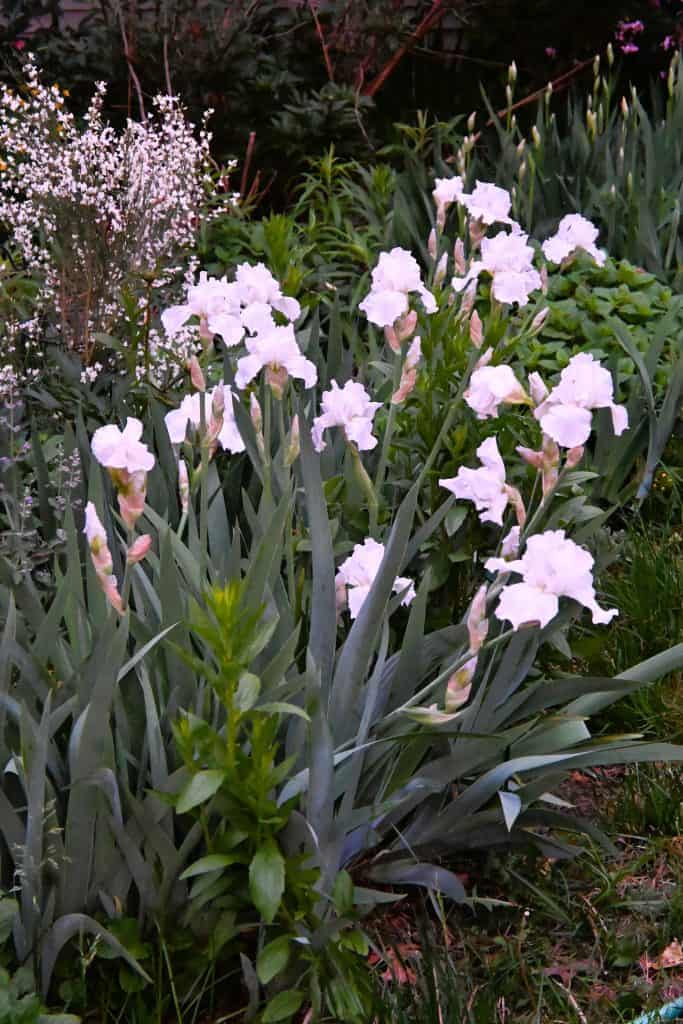

Here’s what’s blooming in town this week to make your walks more enjoyable
By Laura Eisener
There is plenty to enjoy in the garden this week. Tomorrow, May 30, is National Water a Flower Day. It is also the traditional date of Memorial Day, originally known as Decoration Day, since its purpose was to decorate the graves of Civil War soldiers with floral wreaths and bouquets. The name changed to Memorial Day as it became a day to remember all those who died in military service, and observances included ceremonies and other activities in addition to the placing of flowers on the graves. One hundred years after it was first observed in 1868, the date was changed to the last Monday in May.
We have a blue moon to look forward to on Sunday! The first full moon of the month was May 1, and we will be finishing out the month with a second full moon. Of course that means we will have to be very patient waiting to observe the full moon of June, often called the strawberry moon.
The floral symbol of the Saugus Garden Club is the iris, blooming in its glory this week. There are 300 different iris species, and breeders have produced thousands of varieties. But the club’s logo shows a bearded iris. About 40-50 iris species fall into this category. The “beard” is a fuzzy looking line of trichomes, which serves as a nectar guide, leading pollinators down inside the blossom, and also working very efficiently to brush pollen off as the bees move about within the flower. These irises are among the oldest garden flowers, and hybridization began before the current system of botanical nomenclature was established. It is not always clear what the ancestors of some iris varieties were, or even what countries were actually their native range, although most are from Eurasia.
Iris flowers have a distinctive form in which there are 6 colorful parts that many websites call petals, but botanists would call them tepals. This term is used when petals and sepals are very similar. As with tulips 3 of them are actual petals and the 3 slightly lower ones are sepals. Unlike the tulip flower, in which they all curve upward, in iris they take 2 forms: The petals point upward and are called standards, while the 3 sepals droop downward or outward and are known as falls. In previous centuries, the standards were often called “sails.”
The ancient Greek goddess of the rainbow was known as Iris, and this is the origin of the plant’s name. Wherever she walked, flowers supposedly sprang from the ground. Iris flowers bloom in almost every color of the rainbow.
In Saugus, bearded irises usually bloom in late May and early June. Some white ones in my garden have been blooming now for about a week, bent down by the weight of water in last Sunday’s rain, but now propped up and still blooming well. These are the variety Immortality, which often rebloom in late fall. In my childhood, we had light purple flowering irises that were probably an old-fashioned species, Dalmatian or sweet iris (Iris pallida), in a rock garden in the backyard in Lynnhurst. There were some darker purple ones and some yellowish bicolor irises in other gardens in the neighborhood. In high school, I collected some unusual, colorful irises in orange and other colors, but it is nothing compared to what is available today, with a fantastic array of colors, some with frilled and ruffled falls, and many reblooming varieties that produce flowers again in fall.
While there are some small bulb irises that bloomed over a month ago, the first of the bearded irises to bloom in my garden opened just over a week ago. These are the snow-white ones known as ‘Immortality,’ one of the most popular reblooming varieties. It was developed in Canada in the 1980s, and I first saw it blooming in November in a Cambridge, Mass., garden in the mid-1990s. A ruffly orange variety developed in the late 20th century called ‘Firebreather’ just opened on Memorial Day, and several other varieties are just on the verge of opening.